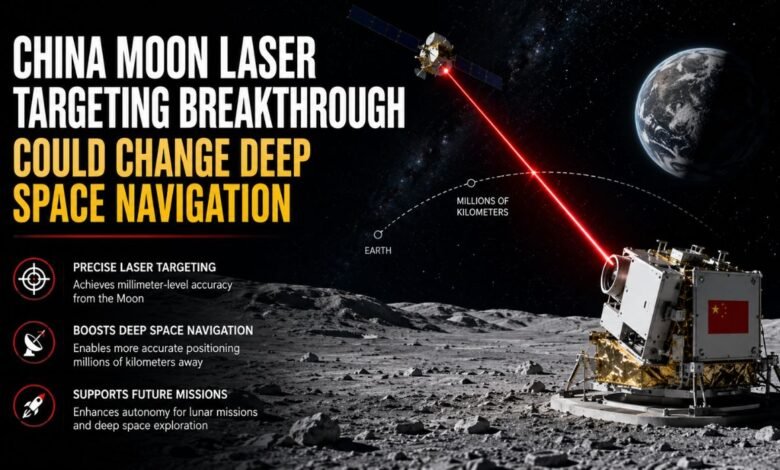
Space exploration is entering a new era, and one of the most interesting developments comes from China. In April 2025, Chinese researchers successfully carried out a daytime laser ranging experiment involving a satellite orbiting near the Moon. While the achievement may sound highly technical, its implications are easy to understand. The breakthrough could help spacecraft navigate more accurately across vast distances, support future lunar missions, and strengthen plans for long-term exploration beyond Earth.
The achievement has attracted international attention because tracking objects near the Moon during daylight is extremely difficult. Scientists must overcome sunlight interference, weak signal returns, and the enormous distance between Earth and lunar space. By successfully completing this experiment, China demonstrated a capability that could become an important part of future deep-space navigation systems.
As nations and private companies continue to invest in lunar exploration, technologies that improve spacecraft tracking and positioning are becoming increasingly valuable. The recent China Moon Laser Targeting breakthrough is therefore more than a scientific experiment. It represents a step toward a future where navigation across Earth-Moon space becomes more precise, reliable, and efficient.
What Is China Moon Laser Targeting?
China Moon Laser Targeting refers to the use of advanced laser ranging technology to accurately determine the position and distance of spacecraft operating in lunar space. During the recent experiment, researchers directed laser pulses from Earth toward the Tiandu-1 satellite. These pulses traveled hundreds of thousands of kilometers through space before being reflected back toward Earth.
By measuring the time required for the laser signal to complete its journey, scientists were able to calculate the satellite’s distance with remarkable precision. Although laser ranging has existed for decades, performing the process in Earth-Moon space under bright daylight conditions represents a significant technological advance.
The experiment demonstrates how laser-based systems can supplement or even improve traditional spacecraft tracking methods. This capability may eventually help create a highly accurate navigation framework for future lunar operations.
Understanding Satellite Laser Ranging
To appreciate the significance of this achievement, it helps to understand how satellite laser ranging works. The concept is surprisingly straightforward. A ground station sends a short laser pulse toward a spacecraft equipped with special reflective devices. When the pulse reaches the spacecraft, it reflects back toward Earth.
Because the speed of light is known with extraordinary accuracy, scientists can determine the exact distance by measuring the pulse’s travel time. Even tiny fractions of a second can reveal highly precise distance measurements.
This level of precision makes laser ranging one of the most accurate tracking methods available today. In space exploration, where even small navigation errors can grow into major problems over long distances, precise measurements are extremely valuable.
Meet Tiandu-1
At the center of this breakthrough is Tiandu-1, an experimental satellite launched in March 2024 as part of China’s expanding lunar exploration program. The satellite serves as a technology demonstration platform designed to test communication, navigation, and tracking systems in Earth-Moon space.
Unlike many traditional satellites that operate close to Earth, Tiandu-1 functions in a much more challenging environment. The spacecraft helps researchers evaluate technologies needed for future lunar missions and long-term operations around the Moon.
Its successful participation in the daytime laser ranging experiment confirms that it can support advanced navigation research and contribute valuable data for future exploration projects.
Why Daytime Laser Tracking Is So Difficult
One of the most remarkable aspects of the China Moon Laser Targeting experiment is that it occurred during strong daylight conditions. This may not sound important at first, but it represents one of the biggest challenges in laser tracking.
Sunlight floods optical sensors with background noise. The returning laser signal from a spacecraft near the Moon is already extremely weak after traveling such a long distance. Detecting that faint signal among intense sunlight is similar to spotting a tiny flashlight beam against a bright afternoon sky.
Scientists must use advanced filtering systems, highly sensitive detectors, and precise timing equipment to distinguish the returning signal from surrounding noise. Achieving this successfully demonstrates a major improvement in China’s deep-space observation capabilities.
How The Experiment Was Conducted
During the experiment, researchers used ground-based laser systems capable of sending highly focused pulses toward Tiandu-1. These systems were carefully synchronized with precision timing equipment to measure signal travel times accurately.
The process required exceptional accuracy. A slight misalignment could cause the laser to miss its target entirely. The satellite’s position had to be known precisely, and the ground station needed to compensate for factors such as atmospheric distortion and Earth’s rotation.
After receiving the reflected signals, researchers analyzed the data to verify the measurements. The successful results demonstrated that reliable laser ranging is possible even under conditions previously considered highly challenging.
Laser Tracking Versus Traditional Radio Navigation
For decades, spacecraft have relied primarily on radio signals for navigation and communication. Radio tracking remains highly effective, but laser-based systems offer several important advantages.
Laser signals can provide much greater measurement precision. This allows scientists to determine spacecraft positions more accurately and make finer navigation adjustments when necessary. Laser systems can also support future high-capacity communication networks between Earth and spacecraft.
Rather than replacing radio systems entirely, laser technologies are expected to complement existing methods. Together, they could create more robust and reliable navigation networks for future missions.
How China Moon Laser Targeting Could Improve Deep Space Navigation
Deep-space navigation becomes increasingly difficult as spacecraft travel farther from Earth. Tiny positioning errors can become significant over millions of kilometers. Accurate tracking is therefore essential for mission success.
The China Moon Laser Targeting breakthrough offers a potential solution. By providing highly precise distance measurements, laser ranging can help spacecraft maintain correct trajectories, perform accurate orbital maneuvers, and reach their destinations more efficiently.
Future missions traveling to the Moon, Mars, or other destinations may benefit from navigation systems that combine radio and laser technologies to achieve unprecedented levels of accuracy.
The Role Of Laser Navigation In Future Moon Missions
As space agencies move beyond short-term lunar visits and begin planning long-term operations on and around the Moon, navigation becomes one of the most important challenges. Future lunar missions will likely involve orbiters, robotic landers, cargo spacecraft, and eventually crewed vehicles traveling regularly between Earth and the Moon. Each of these missions will require precise positioning and timing information.
The recent China Moon Laser Targeting achievement could help provide that accuracy. Laser ranging may support safer lunar landings, more efficient orbital operations, and improved coordination between multiple spacecraft. In the future, a network of satellites around the Moon could use similar technologies to create a lunar navigation system similar to the GPS networks people use on Earth today.
China’s Growing Ambitions In Lunar Exploration
China has steadily expanded its space program over the past two decades. Its lunar exploration efforts have included successful orbiters, landers, rovers, and sample-return missions. These achievements have positioned the country as one of the leading participants in modern space exploration.
The Tiandu satellites are part of a broader effort to build communication and navigation infrastructure in Earth-Moon space. Instead of focusing only on individual missions, China is developing technologies that could support a long-term lunar presence. The successful daytime laser ranging test demonstrates progress toward that goal and shows how navigation systems are becoming a central part of future exploration strategies.
How This Development Fits Into The Global Moon Race
Interest in the Moon has increased dramatically in recent years. Governments and private companies view the lunar environment as a valuable destination for scientific research, technology testing, and future economic activities. Multiple nations are planning missions that will place spacecraft, instruments, and eventually people on the Moon.
In this environment, navigation technology is becoming a strategic capability. Reliable tracking systems reduce mission risks and improve operational efficiency. The China Moon Laser Targeting breakthrough highlights how countries are investing not only in rockets and spacecraft but also in the supporting infrastructure required for sustained lunar exploration.
As competition and cooperation continue to shape the future of space exploration, precise navigation systems may become just as important as launch vehicles and landers.
Potential Benefits Beyond The Moon
Although the experiment focused on a satellite near the Moon, the underlying technology could have applications far beyond lunar missions. Deep-space exploration requires spacecraft to travel enormous distances while maintaining accurate navigation. The farther a spacecraft travels, the more valuable precise tracking becomes.
Laser ranging technologies could eventually support missions to Mars, asteroids, and other destinations throughout the solar system. Future explorers may depend on advanced optical navigation systems to guide spacecraft through complex trajectories and ensure safe arrivals at distant targets.
Many of the technologies used in interplanetary missions are first tested closer to Earth. In this sense, lunar space often serves as a proving ground for future exploration capabilities. The success of this experiment may therefore contribute to developments that extend well beyond the Earth-Moon system.
Challenges Scientists Still Need To Overcome
Despite the success of the experiment, several technical challenges remain. Daytime laser ranging requires highly sophisticated equipment and ideal operating conditions. Expanding the technology for routine use across many missions will require additional testing and refinement.
Atmospheric interference remains a major obstacle. Weather conditions, cloud cover, and air turbulence can affect laser signals traveling between Earth and space. Scientists must continue improving detection systems and signal-processing techniques to ensure consistent performance.
Infrastructure requirements also present challenges. Establishing a global network of advanced laser ranging stations would require significant investment and international cooperation. While the recent achievement represents important progress, further development is necessary before laser navigation becomes a standard tool for deep-space missions.
What This Breakthrough Means For The Future Of Space Exploration
The importance of the China Moon Laser Targeting breakthrough extends beyond a single experiment. It demonstrates that highly precise tracking is possible under conditions previously considered extremely difficult. This capability could improve spacecraft navigation, strengthen lunar infrastructure, and support more ambitious exploration goals.
As humanity prepares for a future that includes permanent lunar operations and deeper exploration of the solar system, accurate navigation will become increasingly important. Technologies such as laser ranging may help create the foundation for safer, more reliable, and more efficient space travel.
The successful test involving Tiandu-1 shows that the next generation of space navigation systems is already taking shape. While many challenges remain, the achievement offers a glimpse of how future spacecraft may navigate the vast distances between worlds.
Conclusion
The China Moon Laser Targeting breakthrough represents a significant milestone in modern space technology. By successfully conducting a daytime laser ranging experiment with the Tiandu-1 satellite near the Moon, Chinese researchers demonstrated an impressive level of precision and technical capability.
More importantly, the achievement highlights the growing importance of navigation systems in the future of space exploration. Whether supporting lunar bases, guiding robotic missions, or helping spacecraft travel to Mars and beyond, accurate tracking technologies will play a critical role in the decades ahead.
As of 2026, this achievement stands as an important step toward building the infrastructure needed for long-term operations in Earth-Moon space. While the experiment focused on a single satellite, its implications extend far beyond one mission. It signals progress toward a future where deep-space navigation becomes more accurate, reliable, and capable than ever before.
FAQs About China Moon Laser Targeting
What Is China Moon Laser Targeting?
China Moon Laser Targeting refers to the use of laser ranging technology to measure and track the position of spacecraft operating near the Moon. The system sends laser pulses from Earth to a spacecraft and measures the return signal to calculate precise distances.
Why Is The Tiandu-1 Satellite Important?
Tiandu-1 serves as a technology demonstration satellite for China’s future Earth-Moon communication and navigation infrastructure. It helps researchers test systems that may support future lunar exploration missions.
Why Was The Daytime Test Considered A Breakthrough?
Daylight creates strong background noise that makes detecting reflected laser signals extremely difficult. Successfully performing laser ranging under these conditions demonstrates a significant improvement in tracking capabilities.
How Far Away Was The Satellite During The Experiment?
Tiandu-1 was operating in lunar space, roughly hundreds of thousands of kilometers from Earth. The Earth-Moon distance averages about 384,400 kilometers, making precise tracking especially challenging.
How Does Laser Ranging Differ From Radio Tracking?
Laser ranging generally provides more precise distance measurements than traditional radio tracking. While radio systems remain essential, laser technologies can improve navigation accuracy and support future deep-space operations.
Could This Technology Be Used For Mars Missions?
Yes. Researchers believe advanced laser navigation technologies could eventually help guide spacecraft traveling to Mars and other destinations. Precise tracking becomes increasingly valuable as missions move farther from Earth.
Will Laser Navigation Replace Existing Space Navigation Systems?
Most experts expect laser navigation to complement rather than replace current systems. Future missions will likely use a combination of radio, optical, and laser technologies to achieve maximum reliability and accuracy.
What Does This Achievement Mean For Future Lunar Exploration?
The breakthrough could help support future lunar orbiters, landers, cargo missions, and crewed spacecraft. It also contributes to efforts to build long-term navigation and communication networks throughout Earth-Moon space.
Recommended For You: Ryne AI Helps Bridge the Gap Between AI and Human Writing