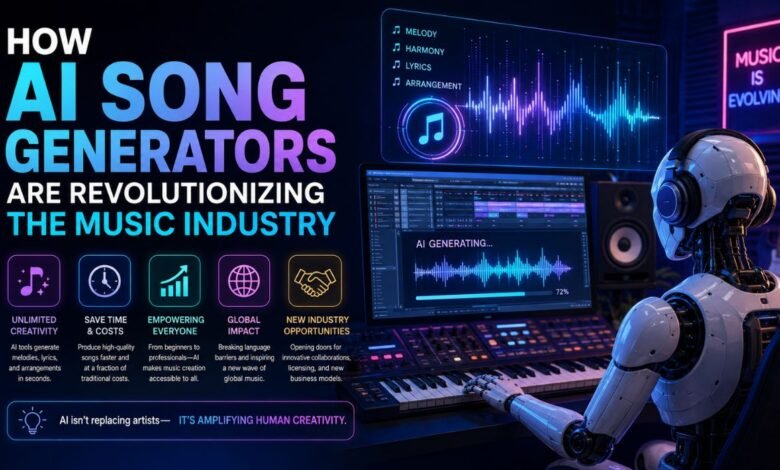
The music industry is undergoing one of the biggest transformations in its history. Artificial intelligence is no longer just assisting music production. It is actively creating songs, generating vocals, composing melodies, and automating workflows that once required entire teams of musicians and producers.
Modern AI Music Generator and AI Song Generator platforms are changing how music is produced, distributed, and consumed. Tools powered by artificial intelligence now allow creators to generate professional-quality music within minutes using simple text prompts.
This revolution is affecting:
- Artists
- Record labels
- Content creators
- Businesses
- Game developers
- Streaming platforms
Some people see AI as the future of music creation. Others fear it could reduce artistic authenticity and threaten creative careers.
The truth is more complicated and far more interesting.
Humanity spent centuries developing musical mastery through discipline and emotional suffering. Then it built algorithms that generate soundtracks while people scroll social media half-asleep. Progress has a bizarre sense of humor.
The History of Music Production
To understand how AI is changing music, it helps to understand how music production evolved over time.
Early Music Production Era
Before digital technology, music production was entirely human-driven.
Artists needed:
- Physical instruments
- Recording studios
- Audio engineers
- Session musicians
- Producers
Music creation required:
- Technical skill
- Expensive equipment
- Studio access
- Years of practice
Producing professional music was difficult and expensive.
Digital Music Revolution
The late 1990s and early 2000s introduced digital audio workstations (DAWs) such as:
- FL Studio
- Ableton Live
- Logic Pro
- Pro Tools
This changed music production dramatically.
Artists could now:
- Produce music from home
- Use virtual instruments
- Record digitally
- Edit tracks more efficiently
The internet and streaming platforms later expanded music distribution globally.
This era democratized music creation, but technical skills were still required.
Rise of AI in Music Production
The next evolution came with artificial intelligence.
AI systems began analyzing:
- Melody patterns
- Chord progressions
- Song structures
- Genre characteristics
- Audio textures
Machine learning models trained on massive music datasets allowed AI to generate original compositions.
By 2024–2026, AI Song Generators became capable of creating:
- Full songs
- Instrumentals
- AI vocals
- Lyrics
- Cinematic soundtracks
- Background music
Popular AI Music Generator tools now include:
- AI-Song.ai
- Suno AI
- Udio
- AIVA
- Soundraw
The industry shifted from “AI-assisted production” to “AI-generated music.”
What is an AI Song Generator?
An AI Song Generator is software that creates music automatically using artificial intelligence.
Users provide prompts such as:
- “Create emotional piano music”
- “Generate cinematic soundtrack”
- “Make upbeat EDM track”
The AI then produces music using:
- Machine learning
- Neural networks
- Predictive algorithms
- Audio pattern recognition
Modern AI Music Generators can create:
- Songs
- Instrumentals
- Vocals
- Sound effects
- Loops
- Beats
Most tools are beginner friendly and require little technical knowledge.
How AI Music Generators Work
AI Music Generators operate by analyzing large collections of existing music.
The AI learns:
- Rhythm structures
- Instrument relationships
- Genre characteristics
- Harmonic patterns
The system then predicts what musical elements should come next.
Basic Workflow
- User enters prompt
- AI analyzes request
- AI generates melodies and arrangements
- System produces playable audio
This process happens within seconds or minutes.
Machines now generate songs faster than most humans choose what to watch on Netflix. Civilization optimized productivity in deeply questionable areas.
How AI is Changing the Music Industry
The impact of AI-generated music is massive.
1. Music Creation is Becoming More Accessible
Traditionally, music production required:
- Expensive software
- Instruments
- Studio access
- Technical training
AI Song Generators remove many of these barriers.
Now almost anyone can create music regardless of experience.
Who Benefits?
- Beginners
- YouTubers
- Small businesses
- Social media creators
- Freelancers
This democratization is one of the biggest industry changes.
2. Faster Music Production
AI Music Generators dramatically reduce production time.
Traditional workflows may take:
- Days
- Weeks
- Months
AI-generated tracks can be created within minutes.
This helps creators:
- Publish faster
- Scale content production
- Reduce editing time
3. Lower Production Costs
Traditional music production often includes:
- Studio fees
- Producers
- Session musicians
- Mixing engineers
AI-generated music reduces many of these costs.
This especially benefits:
- Indie creators
- Startups
- Small agencies
4. Rise of Personalized Music
AI systems are increasingly capable of generating personalized audio experiences.
Future systems may create music based on:
- User mood
- Activity
- Preferences
- Environment
Examples include:
- Workout playlists
- Gaming soundtracks
- Meditation music
- Adaptive streaming audio
Impact on Artists
AI music technology creates both opportunities and challenges for musicians.
Positive Impact on Artists
Faster Workflow
Artists use AI tools for:
- Song ideas
- Beat generation
- Melody experimentation
Creative Assistance
AI helps musicians overcome:
- Writer’s block
- Production limitations
- Time constraints
Independent Music Production
Artists can produce music without large budgets.
Challenges for Artists
Copyright Concerns
Many artists worry AI models train on copyrighted music without permission.
Competition Increase
AI lowers entry barriers, increasing market competition.
Fear of Replacement
Some musicians fear AI-generated music could reduce demand for human creators.
Despite these concerns, many artists now use AI as a collaborative tool rather than viewing it as a direct replacement.
Impact on Record Labels
Record labels are also adapting to AI-driven production.
Advantages for Labels
Faster Content Production
Labels can generate demos and experimental tracks quickly.
Lower Costs
AI reduces production expenses.
Data-Driven Music Creation
AI systems analyze listener trends and audience preferences.
Risks for Labels
Copyright Lawsuits
The industry is already seeing legal disputes involving AI-generated music and training data.
Market Saturation
Mass AI-generated content may increase competition and reduce uniqueness.
Impact on Content Creators
Content creators are among the biggest users of AI Music Generator platforms.
YouTubers and Streamers
Creators use AI-generated music for:
- Background music
- Intros
- Outros
- Gaming content
Benefits
- Faster workflow
- Copyright-safe audio
- Lower licensing costs
Marketers and Businesses
Brands use AI-generated music for:
- Ads
- Social campaigns
- Promotional videos
- Brand soundtracks
AI makes custom audio affordable even for small businesses.
Game Developers
Game studios use AI-generated music for:
- Dynamic soundtracks
- Ambient audio
- Adaptive gameplay music
Future games may feature AI-generated music that changes in real time based on player actions.
AI-Generated Music Trends in 2026
Several major trends are shaping the AI music industry.
1. AI Vocal Generation
AI-generated singing voices are becoming more realistic.
Users can now generate:
- Vocals
- Harmonies
- Singing styles
This trend is rapidly expanding.
2. Prompt-Based Music Creation
Text-to-music generation is becoming mainstream.
Users simply type prompts such as:
- “Epic cinematic trailer music”
- “Relaxing lo-fi beat”
The AI handles production automatically.
3. AI Music for Short-Form Content
Platforms like:
- TikTok
- Instagram Reels
- YouTube Shorts
Have increased demand for fast, custom audio.
AI-generated music fits perfectly into this ecosystem.
4. AI-Assisted Human Collaboration
Many musicians now combine:
- Human creativity
- AI-generated ideas
- AI-assisted production
This hybrid workflow is becoming increasingly common.
Will AI Replace Musicians?
This remains the biggest question in the industry.
The answer is likely:
No, but it will permanently reshape music creation.
AI excels at:
- Speed
- Automation
- Scalability
- Functional music generation
Humans still dominate:
- Emotional storytelling
- Live performance
- Artistic identity
- Cultural expression
AI can imitate emotional patterns, but it does not experience human emotion.
Listeners still connect deeply to:
- Personal stories
- Authenticity
- Human vulnerability
Machines generate patterns. Humans turn suffering, memories, and joy into art people remember for decades. One side calculates probabilities. The other survives existence.
Future Predictions for AI Music (2026–2030)
The next few years will likely bring major advancements.
1. Real-Time Adaptive Music
Music may dynamically change based on:
- User activity
- Mood
- Gameplay
- Environment
2. Hyper-Personalized Soundtracks
Streaming platforms may generate custom songs for individual listeners.
3. AI-Human Collaborative Production
Most professionals will likely combine:
- Human creativity
- AI efficiency
Rather than replacing artists completely.
4. Stronger Copyright Regulations
Governments and labels will likely introduce stricter AI copyright laws.
5. More Realistic AI Vocals
AI-generated singing voices will become increasingly difficult to distinguish from humans.
Advantages of AI Music Generators
Faster music creation
Lower production costs
Beginner accessibility
Scalable content production
Endless experimentation
Limitations of AI Music Generators
Limited emotional authenticity
Repetitive outputs
Copyright concerns
Less human uniqueness
FAQs About AI Song Generators
What is an AI Music Generator?
An AI Music Generator is software that creates music automatically using artificial intelligence.
What is an AI Song Generator?
An AI Song Generator creates songs, melodies, vocals, and instrumentals based on user prompts.
How is AI changing the music industry?
AI is making music production faster, cheaper, and more accessible.
Will AI replace musicians?
AI may automate some workflows, but human creativity and emotional storytelling remain important.
Who uses AI-generated music?
- YouTubers
- Businesses
- Marketers
- Game developers
- Podcasters
- Independent creators
What are the biggest AI music trends?
- AI vocals
- Prompt-based generation
- Personalized soundtracks
- AI-human collaboration
Conclusion
AI Song Generators are revolutionizing the music industry by transforming how music is:
- Created
- Produced
- Distributed
- Consumed
The rise of AI Music Generator platforms has made professional-quality music accessible to millions of creators and businesses worldwide.
Artists, labels, marketers, and developers are all adapting to this new era of AI-powered production.
While AI still cannot fully replicate human emotion and artistic identity, it excels in:
- Speed
- Accessibility
- Scalability
- Automation
The future of music will likely involve collaboration between:
- Human creativity
- Artificial intelligence
- Personalized technology
Between 2026 and 2030, AI-generated music will become even more advanced, realistic, and integrated into everyday digital experiences.
Music once required expensive studios, years of practice, and endless technical work. Now someone types “emotional cinematic soundtrack with piano and strings” into a website and receives a finished track before replying to emails they’ve been avoiding for three days. Technology continues moving at terrifying speed while humanity collectively pretends this is normal.