For most of the last two decades, digital marketing ran on a quiet assumption: that you could follow people around the internet, learn their habits, and target them with uncanny precision. That assumption is now unravelling. Third-party cookies are being phased out, privacy regulation is tightening, tracking is being blocked at the browser and device level, and the frictionless surveillance that powered so much online advertising is becoming harder, costlier, and less reliable. Marketers who built their whole approach on that foundation are discovering that the ground has shifted beneath them.
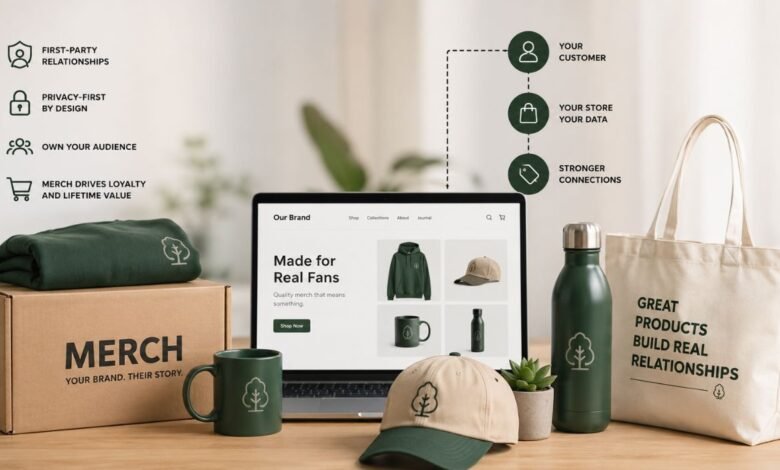
This upheaval has sent businesses scrambling for channels they actually control, and it is reframing how some of them think about physical merchandise. According to Gareth Parkin, founder and CEO of GoPromotional Products, a branded object is about as first-party as a marketing channel gets: you give it directly, on your own terms, with no platform in the middle and no tracking policy that can change overnight. Each item is, in that sense, a small piece of owned media, a direct line to a person that no privacy update can sever.
The comparison is worth drawing out because it reveals something merchandise has always had but that only now looks precious. A digital advert reaches a person through a chain of intermediaries, each of which can change its rules, raise its prices, or cut off access entirely. A physical object reaches a person directly, hand to hand, with nothing in between. The relationship is unmediated, and in a world where mediated relationships are becoming fragile and expensive, an unmediated one is a genuine strategic asset rather than a nostalgic throwback.
There is a consent dimension, too, that fits the privacy-first mood rather well. A person who accepts a branded gift has, in a small but real way, opted in. They chose to take the object, they choose to keep it, and they choose to use it, and every one of those choices is a form of consent that no cookie banner can match. The marketing happens with the person’s willing participation rather than in spite of their defences, which is precisely the direction the whole industry is being pushed toward by regulation and public sentiment alike.
This does not magically solve the measurement problem, and it would be dishonest to pretend it does. The great trade-off of merchandise has always been that it is harder to track than digital, and the death of the cookie does not change that. What has changed is the relative position: as digital tracking becomes less reliable and less socially acceptable, the gap between digital’s measurability and merchandise’s measurability narrows, and merchandise’s other advantages, its permanence, its directness, its consent, look correspondingly more attractive.
The businesses adapting well are treating physical merchandise as part of a broader shift toward owned channels: their own email lists, their own communities, their own physical presence, and their own branded objects. Each of these is something the business controls outright, immune to the platform changes and privacy clampdowns that are making rented audiences so precarious. Merchandise slots naturally into that owned-channel thinking, offering a tangible, direct connection that sits comfortably alongside the digital assets a business genuinely controls.
The principle to carry forward is that control is becoming the scarce and valuable thing in marketing, and physical merchandise offers it in an unusually pure form. In an era when the channels you rent are becoming less dependable, the channel you can literally place in someone’s hand looks less like a relic and more like a hedge. It is direct, it is consented, and it cannot be switched off by a policy change in a distant headquarters.
As privacy-first marketing continues to reshape the landscape, the smart move is to build a portfolio of channels you own outright, and to recognise that a well-chosen branded object belongs firmly in that portfolio. It is, quietly, one of the most durable first-party connections a business can make. Ownership, in the end, is the quiet advantage, and the branded object is one of the few marketing assets a business can genuinely say it owns outright from the moment it leaves the box.