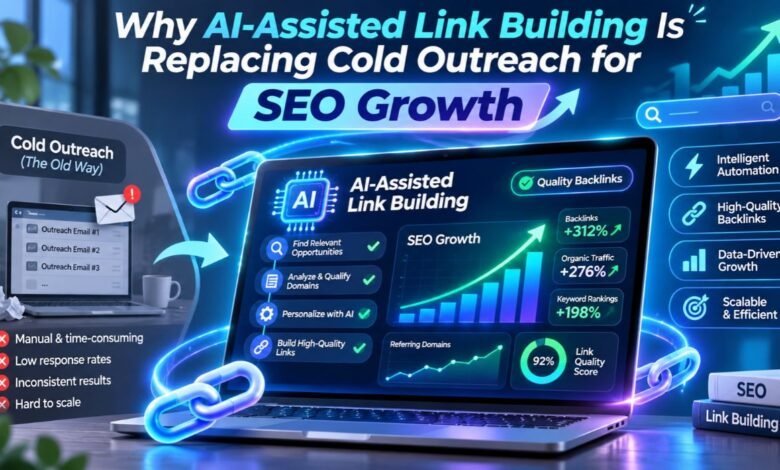
If you run an SEO campaign, you probably know how difficult it has become to get a publisher to reply to a backlink request. Website owners receive countless emails starting with “I loved your recent article,” followed by a guest post or link insertion pitch. Most never receive a response.
That is why SEO teams are changing how they approach link building. Instead of spending hours chasing publishers, they are using AI-powered prospect discovery, backlink analysis, contextual placement opportunities, and structured publisher networks. In 2026, businesses need a more focused approach to earning relevant links and building brand visibility across Google and AI-powered search platforms.
Why Traditional Cold Outreach Is Failing in 2026
Traditional cold email outreach for SEO still works in some situations, but its manual process makes it difficult to scale. Finding suitable websites, checking their metrics, locating editors, writing individual emails, and following up can consume an entire team’s working hours.
The response figures also explain the frustration. A Backlinko study of 12 million outreach emails found that only 8.5% received a response. The research dates back to 2019, so it should be treated as a historical benchmark rather than a current industry average. It also found that personalized email bodies received 32.7% more replies than generic messages.
There is another problem: the cost of manual prospecting. Email verification services, SEO subscriptions, contact databases, and staff time all add up. When teams rush to meet link targets, they can end up approaching unrelated websites simply because those domains have attractive DR or DA scores.
Google also warns against manipulative link practices. Its official spam policies identify automated link creation, excessive exchanges, and paid links intended to manipulate rankings as link spam. The quality of a backlink opportunity deserves more attention than the number of emails sent.
How AI-Assisted Link Building Changes the Workflow
AI-assisted link building uses artificial intelligence, SEO data, and automation to improve how teams discover, assess, and manage backlink opportunities. It can analyze website content, identify relevant topics, compare competitor backlink profiles, and help prepare personalized publisher pitches.
A 2025 Omniscient Digital survey of 105 professionals across 21 countries found that 60.8% used AI to save time, while 49.5% used it to scale personalization. Another 43.3% used AI for data analysis. These figures show how professionals are incorporating AI into existing link-building workflows.
For example, an SEO specialist can use competitor backlink analysis to find publications linking to several competing SaaS brands. AI can then examine those websites, identify suitable articles, and help prepare an outreach message that refers to a genuine editorial opportunity.
Existing, indexed articles can also offer relevant contextual link insertion opportunities. When a publisher agrees to add a useful reference to an appropriate page, the process can avoid the delays involved in commissioning an entirely new guest article. However, indexing alone does not guarantee ranking benefits.
The same research matters for Generative Engine Optimization (GEO). A 2025 research paper, Generative Engine Optimization: How to Dominate AI Search, found that third-party earned media can play an important role in the sources used by generative search systems. Relevant editorial mentions may therefore help businesses build broader brand visibility. They do not guarantee citations in ChatGPT, Perplexity, or Google AI Overviews.
Vetted Exchanges and Smart Discovery: The Modern Alternative
Finding a suitable publisher is only one part of the job. SEO teams must also agree on placement terms, confirm that the link is live, and monitor it after publication. Structured publisher marketplaces can simplify these administrative steps by bringing discovery, negotiations, and placement tracking into one workflow.
For example,websites like adsy offers an AI-powered link discovery and publisher marketplace. According to its website, the platform has more than 14,000 member sites and supports link insertions, guest posts, direct purchases, and credit-based exchanges. Its AI Link Finder identifies existing pages that may suit a website’s subject, while its dashboard tracks placements and link status.
Rather than spending weeks chasing unresponsive editors, SEO teams can use AI-assisted link building platforms to explore relevant publisher opportunities and manage placements in one place.
The credit-based system also gives website owners another way to participate. They can offer placements on their own sites, earn credits, and use those credits to access other publishing opportunities. This can make campaign administration easier for agencies managing multiple clients.
Before choosing any placement, however, check the publisher and its editorial standards yourself. A platform’s link guarantee concerns placement availability, not guaranteed Google rankings or organic traffic. Google requires paid links and qualifying link exchanges to use appropriate attributes such as rel=”sponsored” or rel=”nofollow” when applicable.
Why Relevance-First Link Building Works Across Every Niche
A backlink should make sense in the context of the page where it appears. A technology article linking to a relevant software resource gives readers a logical next step. An unrelated link placed simply to increase a domain’s backlink count offers much less editorial value.
This is why topical relevance, audience alignment, and useful content should guide backlink acquisition strategies. The same principle applies to businesses with very different customers.
B2B and SaaS brands
Software companies often compete for searches involving product comparisons, integrations, features, and specific business problems. A relevant mention in a technology publication or SaaS resource can introduce a product to readers already researching that category.
For example, a project management platform may benefit from a contextual reference in an article about remote team productivity. AI-powered prospect discovery can help identify publications covering these subjects, while competitor backlink analysis can reveal editorial opportunities that a brand has not yet explored.
Hyper-local home service businesses
Local service providers need links that support their actual market and services. A plumbing company in Chicago, for instance, has more reason to pursue a relevant local housing or property resource than an unrelated international entertainment blog.
The same approach applies to pest control businesses. Seasonal pest problems, property maintenance, rodent prevention, and local homeownership are natural subjects for relevant editorial mentions.
For a regional provider such as Wausau pest control, contextual references in Wisconsin home improvement, property management, or local community publications can reinforce its connection to the services and location it serves. A handful of suitable references can be more meaningful than dozens of unrelated directory listings.
4 Things to Check Before Placing Any Backlink
AI can shortlist websites, but a human should make the final decision. Before approving a high-quality backlink, check these four points:
- Topical alignment: Does the linking page discuss a subject related to your website, product, or service? Check the actual article rather than relying on its category label.
- Real organic traffic: Review traffic trends, ranking keywords, indexing, and the quality of visitors. High DA or DR alone does not establish a website’s value.
- Natural anchor text: Use descriptive, branded, and relevant phrases where they fit. Repeating exact-match commercial keywords across placements can create an unnatural backlink profile.
- Clean outbound link profile: Check whether the website publishes useful content or is filled with unrelated commercial links. Review the placement’s editorial context and link attributes, too.
These checks help reduce wasted spend and support more responsible white-hat link building practices.
Conclusion
Cold outreach still has a place in SEO, especially when a campaign offers original research, expert commentary, or genuinely useful content. However, manually searching for thousands of prospects and sending repetitive emails is an expensive way to manage link acquisition.
AI-powered link building gives SEO teams better tools for research, targeting, personalization, and placement management. Combine that efficiency with relevant publishers, careful quality checks, and genuine editorial value, and you have a more practical approach to sustainable SEO growth in 2026.