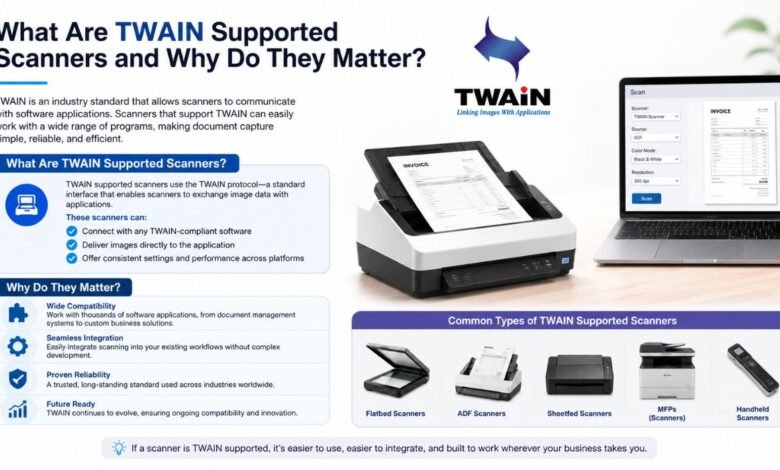
As businesses continue to digitize records and automate information management processes, scanner compatibility has become increasingly important. Organizations rely on document capture solutions that integrate seamlessly with software platforms used for storage, workflow automation, and data management. One technology that plays a significant role in this process is TWAIN compatibility. Understanding the value of twain supported scanners can help businesses select solutions that improve efficiency while supporting long term digital transformation goals.
TWAIN is a widely recognized standard that enables communication between scanning devices and software applications. By providing a consistent interface, TWAIN support allows businesses to connect scanners with document management systems, imaging software, and other business applications without requiring extensive customization. This compatibility helps simplify deployment and creates a more streamlined document capture experience.
Understanding TWAIN Compatibility in Modern Workflows
Modern organizations depend on efficient information flow to support productivity and decision making. Whether processing invoices, contracts, healthcare records, or customer documents, businesses need scanning solutions that integrate smoothly with existing systems.
TWAIN compatibility helps eliminate many of the challenges associated with connecting hardware and software. Instead of relying on proprietary integrations, organizations can utilize standardized communication protocols that support a wide range of applications. This flexibility allows businesses to build workflows that align with their operational requirements while maintaining compatibility across different technology platforms.
For organizations that process large document volumes, scanner performance is equally important. Many businesses rely on a high speed scanner for documents to capture large batches of records efficiently while maintaining image quality and accuracy. When combined with TWAIN support, high performance scanning hardware can contribute to more efficient and scalable document management processes.
TWAIN compatibility also supports future technology investments. As organizations adopt new software solutions over time, maintaining a standardized connection method helps reduce integration challenges and protects existing hardware investments.
How TWAIN Support Improves Software Integration
One of the greatest advantages of TWAIN support is its ability to simplify software integration. Businesses often utilize multiple applications for document management, customer relationship management, accounting, records retention, and workflow automation. TWAIN compliant scanners can work with many of these systems, helping organizations create more connected and efficient workflows.
Improved integration can reduce manual processes that slow productivity. Employees can capture documents directly into business applications without needing to perform additional file transfers or conversion steps. This streamlined approach saves time while reducing opportunities for errors.
Many organizations also use dedicated scanners to support specific workflows and document management needs. When these devices offer strong software compatibility, users benefit from faster implementation, greater flexibility, and a more consistent experience across departments.
In addition to operational efficiency, TWAIN support can contribute to better document accessibility. Information captured through integrated workflows can be indexed, categorized, and stored automatically, making it easier for employees to retrieve records when needed.
As businesses continue to embrace digital transformation initiatives, scanner compatibility remains an important consideration. TWAIN supported scanners provide a practical solution for organizations seeking reliable software integration, efficient document capture, and flexible workflows. By investing in compatible scanning technology, businesses can improve productivity while creating a stronger foundation for long term information management success.