Table of Contents
ToggleIntroduction To Starch Of Maize
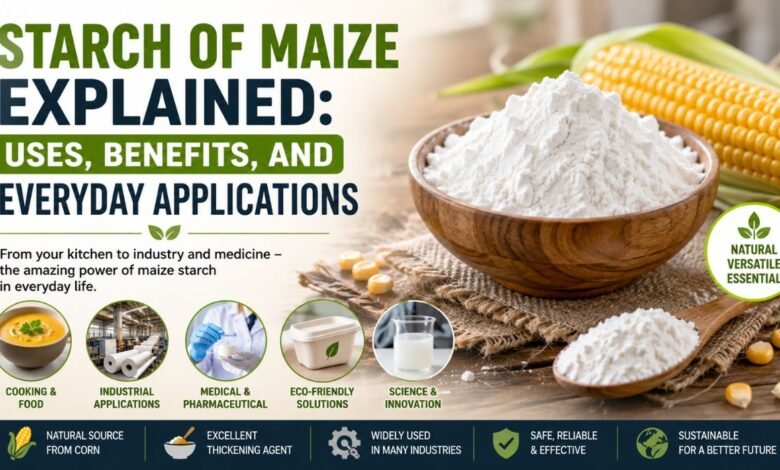
Starch Of Maize, commonly known as Corn Starch or Maize Starch, is one of the most widely used natural ingredients in the world. It is a fine white powder extracted from the inner part of Corn Kernels and plays an important role in Food, Industry, Medicine, and even Scientific Experiments. What makes it so valuable is its ability to thicken liquids, stabilize mixtures, and improve texture in countless products we use every day. From cooking sauces at home to manufacturing biodegradable plastics, Maize Starch is deeply connected to modern life in ways many people do not realize. This article explores its full journey, benefits, and applications in a simple and engaging way.
Quick Bio Information About Starch Of Maize
- Maize Starch Type: Natural Plant-Based Carbohydrate
- Source: Corn Kernels Endosperm
- Appearance: Fine White Powder
- Taste: Neutral And Odorless
- Solubility: Insoluble In Cold Water
- Main Function: Thickening Agent
- Cooking Use: Soups, Sauces, Desserts
- Industrial Use: Paper, Textile, Adhesives
- Medical Use: Blood Sugar Management Support
- Food Industry Role: Stabilizer And Texture Enhancer
- Key Property: Gelatinization When Heated
- Scientific Behavior: Non-Newtonian Fluid Formation
- Eco Feature: Biodegradable Material Source
- Production Method: Wet Milling Process
- By-Products: Animal Feed And Corn Oil
- Safety Note: Flammable In Dust Form
- Global Name (US): Corn Starch
- Global Name (UK): Cornflour
- Modern Use: Bioplastics And Sustainable Packaging
- Scientific Value: Physics And Material Studies
What Is Starch Of Maize
Starch Of Maize is a carbohydrate extracted from the Endosperm of Corn Kernels. It is almost pure starch, meaning it contains very little protein or fat. It is known by different names depending on the region, such as Corn Starch in the United States and Cornflour in the United Kingdom. It is naturally odorless, tasteless, and smooth, which makes it ideal for both cooking and industrial use. Because of its neutral nature, it blends easily into liquids without changing flavor or color.
How Starch Of Maize Is Produced
The production of Maize Starch begins with a process called Wet Milling. First, Corn Kernels are soaked in water for many hours to soften them. This soaking helps separate the different parts of the kernel. The Germ, Fiber, and Starch are then separated carefully. The starch portion is washed repeatedly to remove impurities and then refined into a fine powder. Finally, it is dried and packaged. This process is highly efficient, and almost every part of the corn is used in some form, including animal feed and corn oil production.
Physical And Chemical Properties Of Maize Starch
Maize Starch has unique properties that make it extremely useful. It appears as a fine white powder that feels soft to the touch. When mixed with cold water, it does not dissolve but forms a suspension. When heated, it thickens liquids through a process called Gelatinization. It can also behave as a Non-Newtonian Fluid when mixed with water, meaning it can act like both a liquid and a solid depending on pressure. These properties make it valuable in both science and industry.
Everyday Culinary Uses Of Maize Starch
In cooking, Starch Of Maize is widely used as a Thickening Agent. It is commonly added to soups, sauces, gravies, and custards to improve texture and consistency. Unlike flour, it creates a clear and glossy finish, which is especially useful in desserts and Asian cuisine. It is also used to keep powdered sugar smooth and prevent clumping. In fried foods like Chicken Nuggets, a light coating of Maize Starch helps create a crispy outer layer by reducing moisture on the surface.
Maize Starch In The Food Industry
Beyond home cooking, Maize Starch plays a major role in the global Food Industry. It is used in processed foods to improve texture, stability, and shelf life. Products like Yogurt, Cheese, Instant Soups, and Ready Meals often contain small amounts of starch to maintain consistency. Food manufacturers also use it as a cost-effective ingredient to enhance product structure without changing taste. Its ability to blend smoothly makes it a preferred additive in large-scale food production.
Industrial Applications Of Maize Starch
Starch Of Maize is not limited to food. It is widely used in industries such as Paper Manufacturing, Textile Production, and Adhesive Making. In the paper industry, it improves strength and print quality. In textiles, it helps stiffen fabrics during production. It is also used to make adhesives for packaging, labels, and bookbinding. In modern industries, Maize Starch has gained importance in the production of Bioplastics like PLA, which are used in eco-friendly packaging and 3D Printing materials.
Medical And Pharmaceutical Uses
In the medical field, Maize Starch serves several important functions. It is used as an Anti-Stick coating for latex gloves, condoms, and medical equipment to prevent surfaces from sticking together. It is also used in controlled dietary treatments for people with Glycogen Storage Disease, where it helps maintain stable blood glucose levels over time. Because it is natural and safe, it is widely accepted in pharmaceutical formulations and medical manufacturing.
Scientific Behavior And Non-Newtonian Properties
One of the most fascinating aspects of Maize Starch is its behavior in scientific experiments. When mixed with water, it creates a substance commonly known as Oobleck. This mixture behaves strangely because it becomes solid when pressure is applied and turns liquid when relaxed. This is an example of a Non-Newtonian Fluid. This property helps scientists study material behavior and is also used in educational demonstrations to explain physics concepts in a simple and visual way.
Benefits Of Starch Of Maize In Daily Life
The benefits of Maize Starch are wide-ranging. It is affordable, easy to find, and highly versatile. It improves food texture, supports industrial manufacturing, and even contributes to eco-friendly product development. It is biodegradable, which makes it more environmentally friendly compared to synthetic additives. Its ability to serve multiple industries makes it one of the most important plant-based ingredients in the world today.
Safety And Handling Considerations
Although Maize Starch is safe in normal use, it can become hazardous in large industrial quantities. As a fine powder, it is highly flammable and can cause Dust Explosions if suspended in air and exposed to ignition sources. For this reason, industrial facilities follow strict safety guidelines when handling it. In everyday kitchen use, however, it is completely safe when stored properly in a dry place.
Maize Starch Vs Other Common Starches
Starch Of Maize is often compared with Potato Starch and Tapioca Starch. Maize Starch is known for creating a clear, glossy texture, making it ideal for sauces. Potato Starch produces a thicker and more elastic texture, while Tapioca Starch is known for its chewy consistency. Each type of starch has unique properties, but Maize Starch remains the most commonly used due to its availability and versatility.
Interesting Facts About Maize Starch
Maize Starch has many interesting uses that go beyond cooking and industry. It is used in baby powder, biodegradable plastics, and even certain types of packaging materials. It was first developed for industrial use in the 19th century before becoming a kitchen staple. It can also absorb moisture efficiently, which is why it is often used in products designed to stay dry and smooth.
Environmental Impact And Sustainability
Modern production of Maize Starch is increasingly focused on sustainability. Since it comes from Corn, a renewable crop, it is considered an eco-friendly raw material. Many industries are shifting toward Maize Starch-based Bioplastics to reduce plastic pollution. Its natural origin and biodegradability make it an important ingredient in the global movement toward greener manufacturing solutions.
Global Importance Of Maize Starch
Today, Maize Starch is used worldwide in both developed and developing economies. It supports major industries such as Food Processing, Pharmaceuticals, Packaging, and Agriculture. Its global demand continues to grow as companies look for natural, cost-effective, and sustainable ingredients. It has become an essential part of modern industrial supply chains.
Final Thoughts On Starch Of Maize
Starch Of Maize is far more than a simple kitchen ingredient. It is a powerful natural material that connects food, science, industry, and medicine in surprising ways. Its versatility, safety, and sustainability make it one of the most important starches in the world. As industries continue to evolve in 2026 and beyond, Maize Starch will remain a key ingredient in creating safer, greener, and more efficient products for everyday life.
FAQs About Starch Of Maize
What Is Starch Of Maize Used For
Starch Of Maize is mainly used as a thickening agent in cooking and as an industrial ingredient in paper, textiles, adhesives, and bioplastics. Its versatility makes it essential in many everyday products.
Is Maize Starch The Same As Cornflour
Yes, Maize Starch and Cornflour refer to the same substance in most countries. However, the term Cornflour in some regions may also refer to finely ground cornmeal, so usage can vary.
Is Starch Of Maize Healthy
Starch Of Maize is safe to consume in normal food quantities. It is a carbohydrate source but contains very little nutrients, so it should be used as part of a balanced diet.
Why Does Maize Starch Thicken Liquids
Maize Starch thickens liquids because its starch molecules swell and form a gel when heated in water, creating a thicker texture known as Gelatinization.
Can Maize Starch Be Used In Industry
Yes, it is widely used in industries such as paper, textiles, packaging, and biodegradable plastics due to its natural binding and thickening properties.
What Makes Maize Starch Environmentally Friendly
Maize Starch is biodegradable and derived from renewable crops like corn, making it a more sustainable alternative to synthetic materials in many applications.
What Happens If Maize Starch Is Overheated
If overheated or boiled too long, Maize Starch can break down and lose its thickening ability, resulting in a thinner liquid.
Is Maize Starch Safe For Everyday Cooking
Yes, Maize Starch is completely safe for cooking when used properly and stored in a dry environment away from moisture.
Recommended For You: TVLIO IPTV Review 2026: Features, Pricing, And Streaming Quality Explained
 AdminMay 23, 2026